Product presentation · Confirm configuration with your quotation
KES / Skin resurfacing
MED-870+ Fractional CO2 Laser Manufacturer
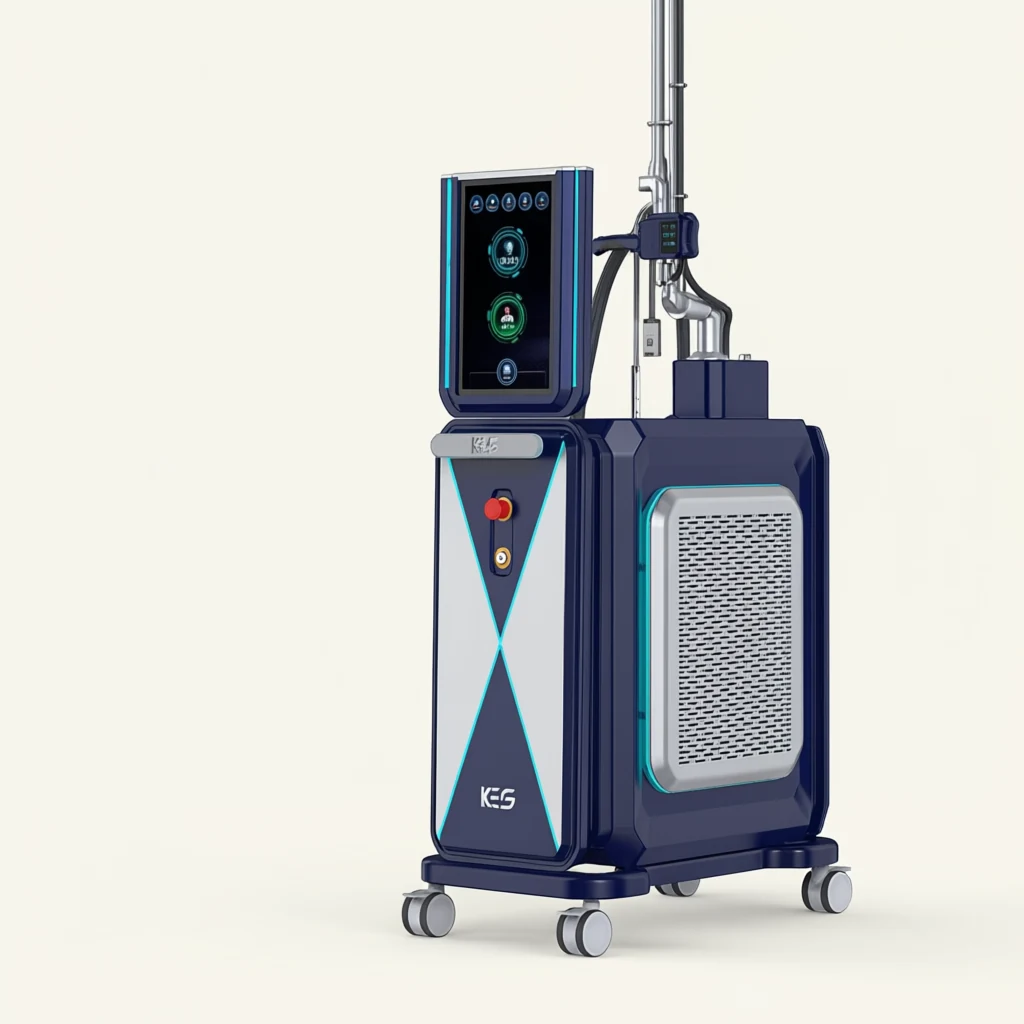
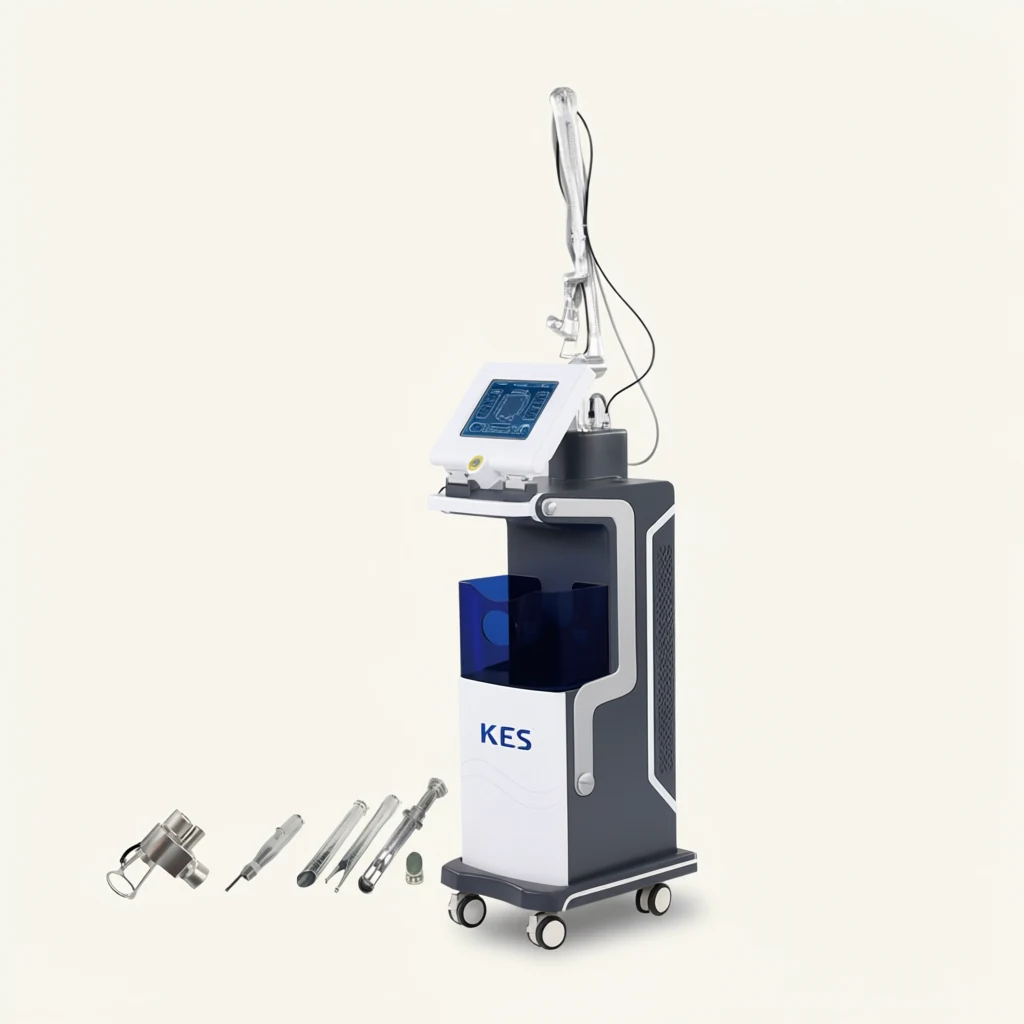
MED-870+ is a fractional CO2 laser platform with a published 1–40W output range, scanning controls and an articulated delivery arm. Review its equipment configuration and prepare a model-specific quotation request for your professional purchasing team.
View specifications ↓For distributors and professional procurement.
Share your destination market when you enquire.
Share your destination market when you enquire.
Technical specifications
| Power Output | 1-40W |
|---|---|
| Laser Type | UltraPulse; CW; Fractional |
| Spot Size | 0.12mm & 1.25mm (adjustable) |
| Spot Density | Up to 102400 dot |
| Scan Size | Up to 20x20mm |
| Scan Shapes | Square; Rectangle; Circle; Triangle; Rhombus; Ellipse; Line |
| Beam Patterns | Standard; Random; Scatter |
| Aiming Beam | 5mW red diode laser, 635nm, adjustable intensity, blink on/off |
| Beam Delivery | Articulated 7-joint arm with up to 360° rotation |
| Cooling | Self-contained, closed cycle |
| Stand-by Working | Continuously for 18 hours |
| Display | 10.4″ True Color LCD Touch Screen |
| Electrical Requirements | 100-240VAC, 20A max., 50/60Hz |
| Net Weight | 52 kgs |
| Dimensions (WxDxH) | 52*38*117cm |
Options and order-specific details should be confirmed in the final quotation.
Identify MED-870+ throughout the purchase
MED-870+ is the complete model reference for this fractional CO2 laser machine. Keep the plus sign in your shortlist, inquiry and purchasing records. Similar model names can refer to different equipment configurations, and a technical comparison loses value if figures from separate products are combined under a shortened name.
The published record gives buyers several concrete points to review: output range, scanning features, delivery arm, display, cooling description and physical dimensions. These details support an equipment discussion. They do not establish a patient treatment plan, a guaranteed clinical outcome or authorization for every use mentioned elsewhere in the market. Request the current documentation for the specific machine and accessories being offered.
Begin by explaining the professional setting and destination for the proposed purchase. If your organization is replacing equipment, identify the requirements you need to preserve rather than assuming compatibility with an existing installation. If you are considering distribution, explain the product and documentation questions your technical team needs resolved. In both cases, a model-specific equipment schedule is a better basis for approval than a generic fractional laser description.
Output and operating-type entries
The published output range is 1–40W. The laser-type entry lists UltraPulse, CW and Fractional. Keep those terms attached to MED-870+ when comparing the product with another platform. They describe entries in the equipment record, not a recommendation to use a particular mode or setting for an individual application.
Ask how the operating types are presented in the current interface and which supplied components apply to them. If a particular feature is essential to the purchase, request a specific description in the quotation and the corresponding documentation. Do not assume that a mode label means every associated accessory is included or that an application is authorized in your destination market.
A useful review should also distinguish the output specification from the electrical requirements. Both concern the machine, but they answer different purchasing questions. Keep separate fields in your comparison for the listed output range and the installation information needed by your site assessor. Avoid ranking offers solely by a maximum number when the components, controls and commercial scope have not yet been made comparable.
Scanning formats and patterns
MED-870+ lists a scan size of up to 20 × 20mm. The available shape names in the record are square, rectangle, circle, triangle, rhombus, ellipse and line. Its beam-pattern entry lists Standard, Random and Scatter. These entries help a procurement team ask informed questions about the scanner and interface, without turning them into instructions for clinical use.
Ask which supplied component provides the listed scanning features and how the controls are identified on the offered machine. If your reviewers need to see a control sequence, request a demonstration focused on the equipment configuration and supported by the current operating documents. A visual example should not be interpreted as a complete treatment protocol or a promise that all settings are interchangeable.
The spot-density entry is listed as up to 102400 dots. Treat it as the published equipment entry rather than a statement of treatment intensity or coverage for an individual. If the definition or conditions matter to your comparison, request an explanation from the manufacturer. Recording the meaning of a specification is more useful than copying an impressive-looking number into a procurement table without context.
When your team reviews the scanning interface, distinguish the shape selection from the beam-pattern selection and ask how each appears in the operating documents. Record unresolved questions in those separate categories. If an included accessory changes the available controls, request an explanation tied to that accessory and the proposed configuration. A screenshot may show an interface state without explaining its prerequisites, so it should be accompanied by the relevant description. This lets a buyer assess the offered equipment more accurately while avoiding assumptions about combinations of settings that the product listing does not itself establish.
Spot entry, aiming beam and articulated arm
The spot-size entry lists 0.12mm and 1.25mm, with an adjustable designation. Ask for clarification of which supplied configuration and components correspond to those entries. Do not infer a continuous operating range or an accessory package that is not described in the offer. Where a particular optical component matters to your purchase, it should have an identifiable place in the equipment schedule.
The aiming-beam specification lists a 5mW red diode laser at 635nm, with adjustable intensity and blink control. This is the aiming-beam entry, not the main treatment-laser wavelength. Keep those functions distinct when creating a technical summary. A supporting optical component should not be used to fill a missing field in a different part of the machine specification.
Beam delivery is described as an articulated seven-joint arm with up to 360-degree rotation. Ask how the arm is protected during shipment, what preparation is required before use and what handling or maintenance instructions apply. For room planning, request the space needed around the delivery system. The cabinet dimensions alone do not define the full working envelope of an articulated arm or its accessories.
Controls, cooling and placement
The display is listed as a 10.4-inch true-color LCD touchscreen. Ask about the language and interface configuration supplied with the proposed order, particularly if several people will review the machine before purchase. A screen-size specification does not establish every software feature, stored program or user-access function. Any such requirement should be stated and confirmed separately.
Cooling is described as self-contained and closed cycle. Request the instructions governing preparation, maintenance and any required materials. Ask which tasks are intended for the operator and which require qualified technical assistance. Do not infer a maintenance-free system from the words self-contained, or substitute a procedure from another model without confirmation that it applies.
The equipment dimensions are listed as 52 × 38 × 117cm in width, depth and height, and net weight is 52kg. Use those figures for an initial placement review. Then request the installation clearances, arm-handling space and access needed for service. If the proposed location has restricted access, share that information before arranging delivery so the logistics discussion addresses the actual receiving conditions.
Electrical, freight and comparison questions
The electrical entry is 100–240VAC, 20A maximum and 50/60Hz. Ask for the installation information applicable to the ordered unit and have the site assessed by qualified personnel. A voltage range on a catalog page is not a complete connection instruction, and the electrical requirements should remain part of the purchasing review rather than being left until the machine arrives.
Request packed dimensions and gross weight for freight planning. Clarify whether the shipping offer includes unloading, unpacking or positioning, and ask how the delivery arm and other supplied components are packaged. If your team needs a particular receiving or inspection procedure, describe it before the order is approved. This allows the logistics scope to be discussed explicitly instead of assumed.
When comparing MED-870+ with another fractional platform, keep each model's record separate. Compare output, scanner information, included delivery components, installation requirements and commercial conditions under consistent headings. The standby-working entry states continuous for eighteen hours; ask for its operating conditions rather than using it to forecast appointment capacity. A purchasing comparison should not turn a standby specification into a guarantee of treatment throughput.
Define the commercial package and handover
Your quotation request should name MED-870+, the destination country, anticipated quantity and the configuration details that affect your decision. List required accessories separately and ask which are included in the offer. If you want branding or other OEM/ODM changes evaluated, describe the proposed changes and ask about feasibility, quantities, approval steps and timing for this platform.
Request the model-specific documents relevant to your intended market and professional setting. Have their applicability assessed where required. A general product category or scanner feature does not establish authorization for a medical application. This page does not promise intimate-treatment uses, surgical uses or any guaranteed resurfacing outcome. Keep the scope of your documentation request tied to the exact equipment and intended lawful use.
Ask for handover, training and support arrangements in writing. Clarify the language and format of instructions, installation responsibilities, warranty coverage and the procedure for technical questions involving the arm, scanner or other supplied components. Separate production readiness from dispatch and transport estimates. Your final approval should identify both the physical equipment package and the responsibilities agreed for getting it to your site and supporting it afterward.
Before you enquire
Questions, answered.
Why should the plus sign remain in the model name?
MED-870+ identifies this specific product. Keep the full name in quotations and equipment records so its specifications are not confused with another platform. Do not transfer display, weight or other values from a similarly named machine.
Is the red aiming-beam wavelength the main laser wavelength?
No. The 635nm value belongs to the listed red aiming-beam specification. It should not be used as the main laser wavelength or substituted for a different specification field. Ask for clarification of any technical value essential to your review.
Are the listed scan shapes treatment instructions?
No. They are equipment feature names. Ask for the current instructions and confirmation of the scanner configuration. Selection and use require the appropriate professional assessment; the shape list does not establish a treatment protocol or result.
Does closed-cycle cooling mean there is no maintenance?
No maintenance-free claim is made. Request the preparation, inspection and maintenance instructions applicable to MED-870+ and clarify which tasks require qualified assistance. Do not infer service intervals from the cooling description alone.
What should I ask about the articulated arm before delivery?
Ask about packaging, receiving checks, installation preparation, handling instructions and the required operating space. Clarify which components are included and who is responsible for handover. These details should be resolved alongside freight and support arrangements in the offer.
Keep exploring
Explore category →In the same collection.
Your next equipment project
Let’s build your shortlist.
Tell us your market, preferred model and configuration questions.